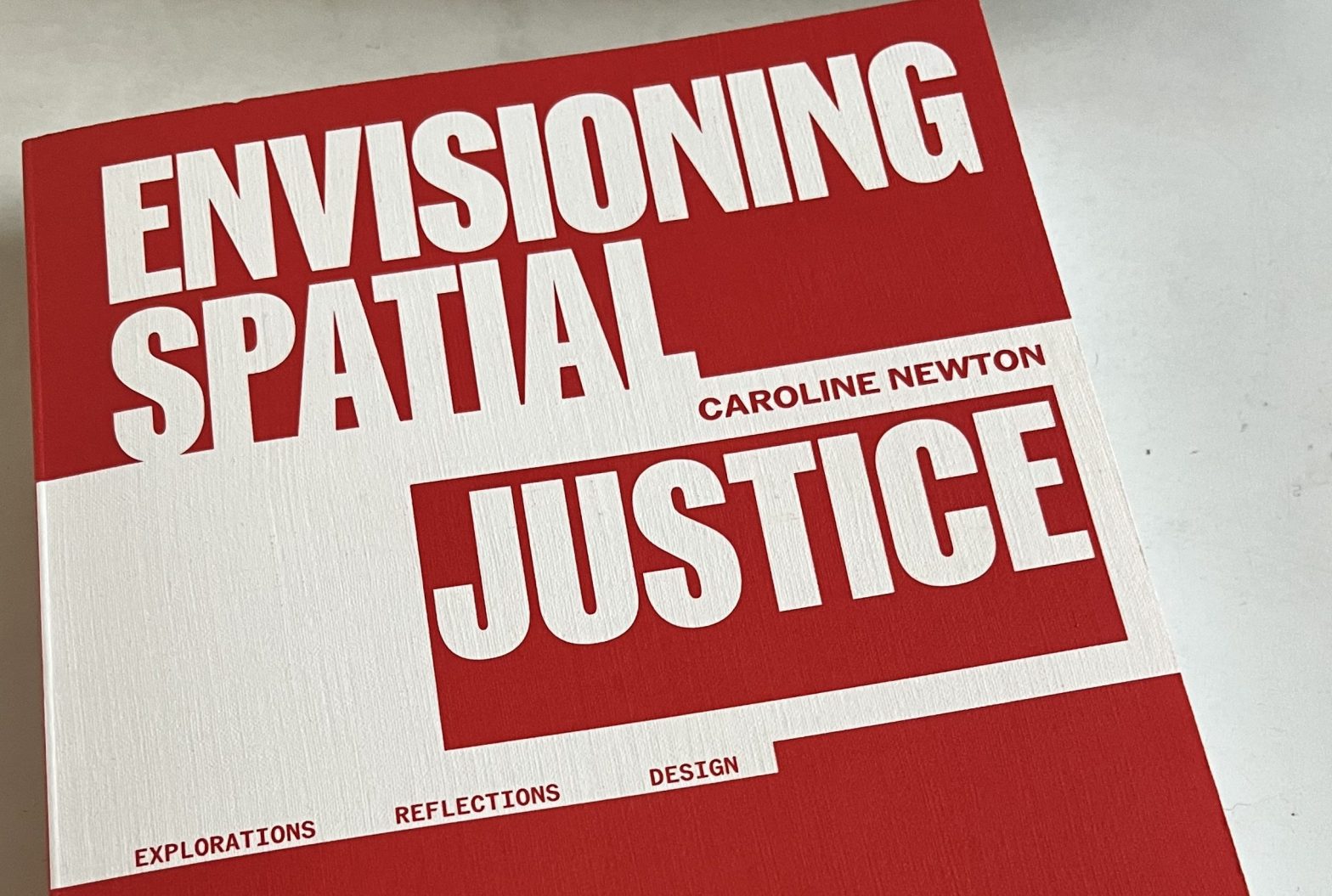
By Caroline Newton
2025, published by JapSam
Radical design, radical ethos: Reclaiming space for spatial justice
In London, wooden benches at bus stops have been replaced with sleek “lean-on bars”. While a commercial catalogue might describe them as ergonomic, in practice, they tell an older person, an exhausted parent, or an unhoused neighbour: you may wait, but you may not rest. A minor design tweak… and yet a crystal-clear message. It shows how space is policy, made concrete.
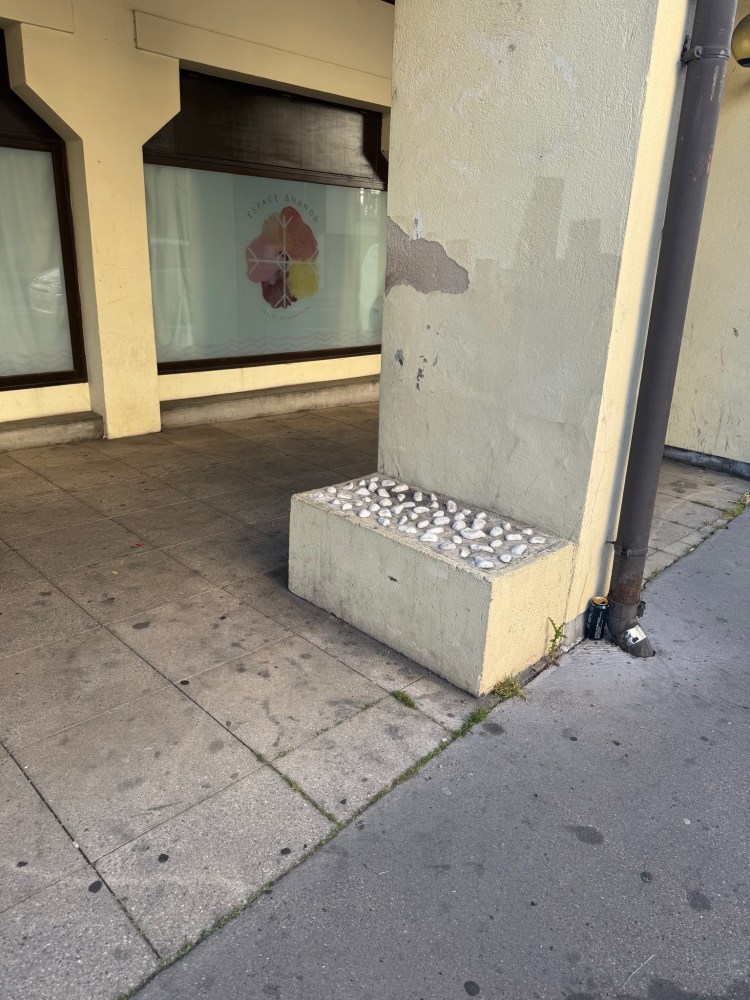


Henri Lefebvre reminded us over fifty years ago that space is socially produced, never a neutral backdrop. Envisioning Spatial Justice picks up that warning and pushes it further: every threshold detail, zoning line, and furniture bolt either reinforces existing power or helps dismantle it.
The book has a deceptively simple premise: justice has a postal code. Inequality is not just found in pay cheques or spreadsheets; it’s mapped onto bus routes, rental contracts, and playground surfaces. Spatial justice, then, invites us to ask three urgent questions:
- Where are resources provided? (Distribution)
- Who gets to decide? (Procedure)
- Whose identities and knowledge are recognised? (Recognition)
A single streetlight can fail all three. Too few in a neglected district? A distributive failure. Installed without input from residents? A procedural failure. Tuned to monitor rather than welcome teenagers? A failure of recognition.
In this light, designers and planners are not neutral technicians. We are political actors. Sasha Costanza-Chock calls this stance design justice: the commitment to treat every project as a chance to close power gaps rather than widen them. However, this requires more than just adding a participation workshop at the end.
Envisioning Spatial Justice argues for what Raquel Gutiérrez Aguilar might call communitarian entanglements: women’s savings circles, migrant mutual-aid kitchens, indigenous urban gardens, forms of collective life already practising reciprocity outside the logic of the market. When these groups are involved not just in the consultation but also in shaping the brief, the design, and the long-term stewardship of the space, design moves from reflecting injustice to redistributing power.
And yet, such work unfolds within what Byung-Chul Han calls neoliberal psychopolitics; a regime that urges us to self-optimise rather than to organise, that colonises our very imagination (as Faranak Miraftab would argue). Envisioning Spatial Justice proposes a (quiet) rebellion: a counter-practice rooted in slow attention and radical hope. Borrowing Han’s own terms, it insists on the vita contemplativa: time to read a wall, trace a bus timetable, ask why a park gate locks at dusk. It is only in that long, slow gaze that we begin to see where small interventions might tip larger scales.
Here, hope is not optimism; it is method.
Studio as rehearsal, and in practice: radical ethics
What does this mean for pedagogy? A critical, engaged studio, like those I’ve been fortunate to lead, can teach students to expose injustice, propose alternatives, and politicise their conclusions. The studio becomes a rehearsal for practice, and practice becomes a radical ethics. Imagine:
- Mapping benches and bus lines against real household routines; redesigning for the unpaid caregiver, the night-shift cleaner, the wheelchair athlete.
- Shifting from one-off public hearings to participatory co-budgeting, where neighbours vote on which flood street to raise first, or which alley to rewild into a cooling micro-park.
- Anchoring every regeneration project in at least one community-run asset, so that value no longer flows only upward.
Critics may argue that these are merely incremental gestures. They are. But so is spatial power: one lean-on bar, one fenced-off square at a time. Reclaiming justice requires countermeasures, enacted just as patiently and persistently.
As Mustafa Dikeç reminds us, gains in spatial justice are fragile, always vulnerable to shifting political winds. The antidote? A professional culture in which differing opinions are not considered an extension of the assignment, but an essential part of it.
So yes, winter is here, as the book concedes. Walls rise. Budgets shrink. Benches grow bars. But every wall can hold a protest mural. Every budget line can be argued into a participatory fund. Every bar can be unscrewed and every carved-out niche can become an improvised urban refuge.
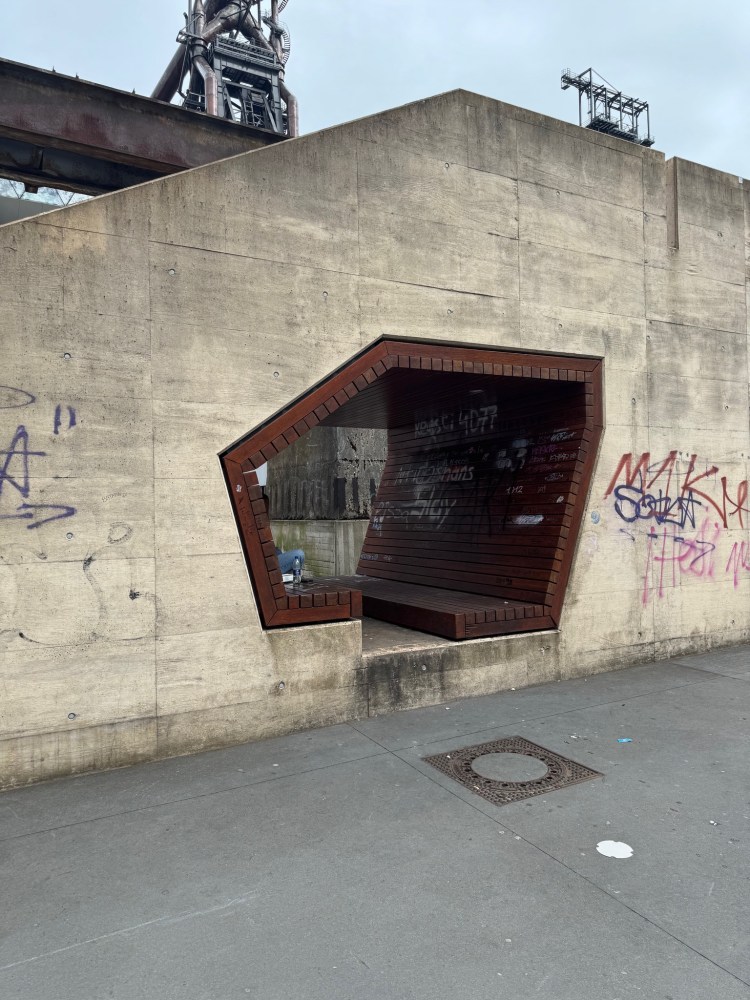
The more we share these counterdesigns … openly, unapologetically … the more common and contagious they become.
The commitment
This is the commitment of Envisioning Spatial Justice: that design grounded in the principles of spatial justice, joined with a radical professional ethos, can still redraw the city’s socio-spatial map.
And so, the invitation passes to us; to students, scholars, practitioners, and activists: Slow your gaze. Design from justice and build the just futures we’ve already imagined.
All images are my own unless stated otherwise.
Related work that touches on some of the issues addressed in this blogpost can be found here:
The TU Delft Centre for the Just city
The Manifesto for the Just City: info on the website https://just-city.org/manifesto-for-the-just-city/. The books can be downloaded from https://books.open.tudelft.nl/home/catalog/series/manifesto-just-city . You can watch the videos on the YouTube channel of the Global Urban Lab.
Further Reading
Costanza-Chock, S. (2020). Design Justice: Community-led practices to build the worlds we need. MIT Press. https://designjustice.mitpress.mit.edu
Dikeç, M. (2001). Justice and the spatial imagination. Environment and Planning A, 33(10), 1785–1805. https://doi.org/10.1068/a3467
Gutiérrez Aguilar, R. (2011). Pistas reflexivas para orientarnos en una turbulenta época de peligro. In Palabras para tejernos, resistir y transformar en la época que estamos viviendo. Pez en el árbol editorial.
Han, B.-C. (2017). Psychopolitics. Neoliberalism and New Technologies of Power. Verso.
Lefebvre, H. (1991). The Production of Space. Blackwell.
Miraftab, F. (2022). Insurgent Practices of Hope & Care for Humane Urbanism. In R. Rocco & C. Newton, Manifesto for the Just City Volume 2. TU Delft OPEN.
 Caroline Newton